
 1348 views
Hovhannes Khachatryan, Central Bank of Armenia: “The Republic is in an active phase of digital transformation”
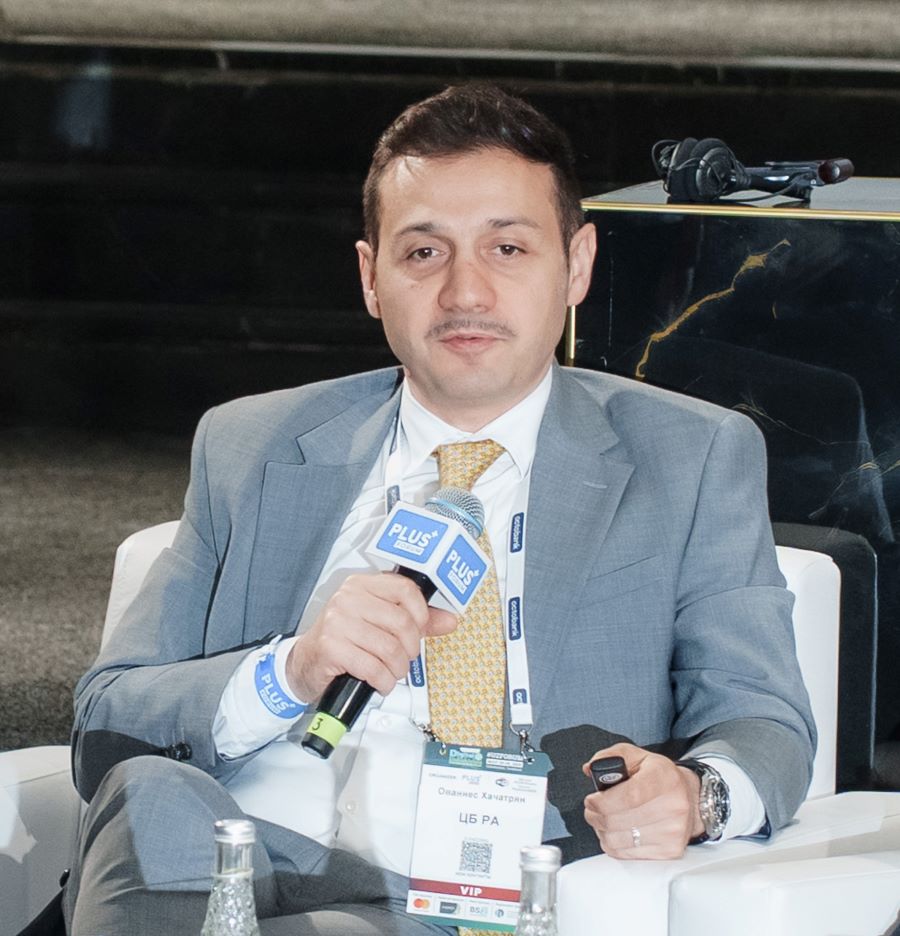
What is the current state of the Armenian payment system? The law on crypto assets regulation - what does it mean for Armenia? How is the universal QR code project progressing? We discuss these and other issues with Deputy Governor of the Central Bank of Armenia Hovhannes Khachatryan on the eve of the International PLUS-Forum FinnoWay Armenia to be held for the first time in South Caucasus region.
Fintech&Retail Eurasia: The International PLUS-Forum FinnoWay Armenia, the first one in the South Caucasus region, will take place in Yerevan on November 11-12, 2025. What global trends and business cases in the field of financial digitalization do you find most relevant for Armenia today?
H. Khachatryan: The forum is really very important for us, since Armenia is in an active phase of digital transformation, in particular in the financial system. We focus on several key areas.
Firstly, the development of open banking: the transition from closed models to ecosystems where banks and fintech companies interact via API, creating new services for citizens and businesses.
Secondly, faster and cross-border payments. Over the past three years, the volume of non-cash local card transactions in Armenia has more than doubled, and their number has tripled, and providing convenient and readily available and affordable international payments will be the next logical step in this direction.
The third area is cyber resilience: as digital services grow, so does the load on security systems, which requires continuous strengthening of digital security.
And finally, it is artificial intelligence and big data that will determine the competitiveness of the financial sector in the coming years.
Fintech&Retail Eurasia: What aspects would you like to draw your colleagues’ attention to at the PLUS-Forum? How, in your opinion, can Armenian banks benefit from participating in FinnoWay Armenia?
H. Khachatryan: We want Armenia's experience to serve as an example of how even a small country can build a modern financial infrastructure. In recent years, we have implemented a faster payment system, launched a universal QR code development project, and migrated to ISO 20022. Armenia is becoming an illustrative example of how the regulator, government, and business can collaborate effectively. For our banks, the PLUS-Forum FinnoWay Armenia is an opportunity to share their best practices with colleagues, to better understand the practical aspects of open banking, digital IDs, and cybersecurity. I am confident that Armenia is on the path towards becoming a regional center for fintech ideas and solutions.
Fintech&Retail Eurasia: Starting from January 2023, the digital reform in Armenia has made significant progress. How do you assess its results and the role of the Central Bank and the government?
H. Khachatryan: You are absolutely right that we are moving quite dynamically. If five years ago (in 2020), the non-cash local card payments accounted for 22% in volume and 57% in number of all retail transactions, in 2024 the indicators reached 47% and 88%, respectively.
This is the result of a consistent government policy and the efforts of the Central Bank aimed at modernization of the financial infrastructure. The Digitalization Agency, which coordinates all digital projects in the country (or at the national level), also plays an important role. Our next steps are the introduction of a universal QR code and large-scale development of open banking.
Fintech&Retail Eurasia: What events and trends 2024–2025 are significant for the financial sector of Armenia?
H. Khachatryan: The main trend of recent years is the growth in the level of financial infrastructure development and independence. While we solved individual, local problems earlier, today we are already seeing systemic changes.
Fintech&Retail Eurasia: What is the current state of the payment system in Armenia?
H. Khachatryan: The payment system is developing dynamically and sustainably. Last year alone, compared to the previous year, payments for goods and services with local cards increased by 41% in volume and by 51% in number. This shows a high level of trust among citizens in new services and their active use. We are seeing a rapid growth in transfers between individuals, as well as a gradual mogration of businesses to digital forms of payment. Our task is to ensure that these processes are as convenient and secure as possible.
Fintech&Retail Eurasia: How are national projects in the financial sector adjusted?
H. Khachatryan: Digital transformation is a live process that requires a flexible approach. We regularly adapt projects to new challenges and realities. Thus, in 2024, special attention was paid to cyber resilience, since the growth of digital transactions requires a higher level of protection. Effective coordination among the Central Bank, government and business has already proven its viability: projects are implemented quickly, while we try to maintain a balance between responsible innovative activity and reasonable regulation.
Fintech&Retail Eurasia: Open Banking and Open API – how do you think they will change the Armenian market?
H. Khachatryan: Open banking is one of the key areas of the future financial sector. Banks will compete not only at the level of traditional financial services, but will start competing with the quality of API, speed of integration, and convenience of digital services. For consumers, this means more freedom of choice and personalized services, and for businesses – new models for higher profitability. We plan to gradually introduce Open Banking over the next three years.
Fintech&Retail Eurasia: What progress is the universal QR code development project making?
H. Khachatryan: We are already close to completing the technical part of the project, and in parallel, work on legislative and standardization issues is underway. A universal QR will allow every citizen to pay for goods and services in one common way – regardless of the bank or payment system. According to our estimates, it can be launched widely as early as 2026.
Fintech&Retail Eurasia: Cryptocurrencies and the law on cryptoassets regulation – what does this mean for Armenia?
H. Khachatryan: We have chosen the path of reasonable regulation. Armenia is open to innovations and fintech startups, but at the same time, we must ensure the protection of consumer rights. The new law on cryptoassets creates a legal framework for the development of services related to digital assets and sets clear rules of the game. The prospects in this area are very broad – from crypto exchanges to services for the tokenization of real and financial assets using smart contracts.
Fintech&Retail Eurasia: What is the role of Big Data?
H. Khachatryan: Big Data is already energetically used by banks in scoring and fraud fighting. For example, the analysis of transaction data helps to quickly identify suspicious transactions. The next step is the personalization of financial services and forecasting customer behavior. At the same time, data protection and compliance with ethical standards remain critically important.
Fintech&Retail Eurasia: Artificial intelligence in finance – how do you assess its role and place?
H. Khachatryan: AI is already used in transaction monitoring, chatbots and credit scoring. Initiatives in the field of generative AI are gradually emerging, although those are long-term projects that require heavy investments. At the national level, we see the task of stimulating research and creating conditions for the development of an AI hub in Armenia.
Fintech&Retail Eurasia: Information security and antifraud – what is being done in this area?
H. Khachatryan: This is one of our top priorities. We understand that along with the growth of digital payments, the activity of fraudsters is also growing. Therefore, we are toughening the requirements for the cyber resilience of banks, establishing coordination with law enforcement agencies and paying great attention to the financial literacy of the population. Above that, a key step in this direction is the introduction of the Zero Liability Policy mechanism in the banking system. The initiative is already at the phase of development by the industry, and we hope to see the first products on the market soon.